


Last Updated: November 10, 2026
Quick Summary
Choosing dog turmeric supplements without additives means reading the full ingredient list and checking for sweeteners, colourings, preservatives, binders and fillers. A short label naming turmeric or curcumin clearly, with its curcuminoid content stated, is the simplest option to monitor. Always check the product with your vet before starting.
- Xylitol is toxic to dogs and should never appear in any dog product.
- Ingredients are listed by weight, so the first few items make up most of the product.
- Front-of-pack terms such as natural or pure have no fixed legal meaning for pet products.
- Introduce turmeric gradually over about a week, starting at a quarter of the recommended dose.
- Tell your vet about any supplements, especially if your dog takes prescribed medication.
Table of Contents
- Why Additive-Free Matters When Choosing Dog Turmeric Supplements
- What the Research Does and Does Not Show About Turmeric for Dogs
- Reading Dog Supplement Ingredient Labels Line by Line
- Turmeric Powder, Standardised Extract or Curcumin: Which Form to Choose
- Turmeric Dosage for Dogs: Reading the Label by Body Weight
- How to Introduce Turmeric to Dogs Safely
- Checking for Turmeric and Medication Interactions in Dogs
- Choosing Your Dog's Turmeric Supplement and Speaking With Your Vet
- Frequently Asked Questions
Why Additive-Free Matters When Choosing Dog Turmeric Supplements
Choosing dog turmeric supplements without additives starts with a simple question: what else is in the product besides turmeric? Many soft chews and powders contain flavourings, preservatives, colourings, binders or fillers. Each one is an extra ingredient your dog eats every day, often for months or years.
Dogs with sensitive stomachs or known skin reactions are the animals most likely to react badly to extra ingredients. For these dogs, a shorter, simpler ingredient list is easier to monitor. When a problem appears, you can work out what caused it.
Fewer ingredients also make labels easier to check. You can see exactly what your dog is eating and compare products fairly.
What the Research Does and Does Not Show About Turmeric for Dogs
Turmeric and curcumin are widely studied, but most of the evidence comes from research in people and laboratory settings. A 2023 review of turmeric and curcumin research, Turmeric and Curcumin: Health-Promoting Properties in Humans versus Dogs, reports lower levels of several inflammatory and oxidative-stress markers in dogs fed curcumin. For the wider evidence on wholefood turmeric, see our review of wholefood turmeric supplements. The review does not give full numerical effect sizes, so owners should read these findings as early signals rather than proven treatment.
For safety in animal feed, the EFSA Panel on feed additives (FEEDAP) concluded that turmeric extract added to feed for all animal species is safe at the maximum proposed use level of 15 mg/kg. This is a feed-safety assessment, not a dog-specific supplement recommendation.
Supplements are not medicines. Turmeric is not a substitute for veterinary care for joint pain, skin allergies or digestive problems.
Reading Dog Supplement Ingredient Labels Line by Line
Start with the ingredient list, not the front label. Ingredients are generally listed in descending order by weight, so the first few items usually make up most of the product. Front-of-pack claims such as "natural", "pure" or "no nasties" are marketing terms and do not have a fixed legal meaning for pet products, so they tell you little on their own.
Work through the list in this order:
- Turmeric or curcumin. Confirm the botanical name is stated (Curcuma longa) and whether the label refers to root powder, extract or curcumin. A vague term such as "turmeric blend" tells you nothing about the active content.
- Sweeteners and flavourings. Look for sugar, glucose syrup, xylitol, sorbitol or liquorice. Xylitol is toxic to dogs and should never appear in a dog product. "Natural flavouring" is a catch-all term that can cover many substances; if it is listed, ask what it contains.
- Preservatives and colourings. Check for tocopherols (generally low-concern antioxidants), sorbates, benzoates, sulphites and synthetic colours. A product with no colourings will usually say so, because colour is an easy thing to leave out and an easy thing to claim.
- Binders and fillers. Starches (rice, potato, tapioca), gums (xanthan, guar, acacia), cellulose and silica are common. These are not harmful in small amounts, but they are the extra ingredients an additive-free buyer is usually trying to avoid.
- Oils and carriers. Identify the oil (for example coconut, olive or sunflower) and whether it is the carrier for the curcumin. Oil-based products are often marketed for absorption, which is a separate question from additive content.
- Capsule or chew base. For capsules, check whether the shell is gelatin, hypromellose (plant-based) or another material. For chews, the base ingredients are the main additive risk.
For each item, ask one question: is it doing a job that the turmeric itself cannot do? If not, it is an additive by your definition.
Distinguishing genuinely simple products from ones with hidden carriers
A product can be labelled additive-free and still contain processing aids, anti-caking agents or carriers that are not listed prominently. Look for these signals:
- The ingredient list is short and every item is named specifically rather than grouped under a generic term.
- The label states the curcuminoid percentage, not just the total product weight, so you can see what the active content is.
- Terms such as "proprietary blend" or "herbal complex" are used without listing each component by weight. These phrases do not automatically mean the product is unsafe, but they prevent you from checking what your dog is eating.
- The manufacturer will state in writing which excipients are used and in what quantity.
Watch out: a product that appears simple on the front can list several additional ingredients in small print on the back, or in a separate "other ingredients" line. Always read the full panel.
If the label is unclear after this check, contact the manufacturer and ask for the full ingredient specification. A reputable supplier can usually answer within a few days. If they cannot or will not, treat that as a reason not to buy.
Turmeric Powder, Standardised Extract or Curcumin: Which Form to Choose
The three main forms differ in how much curcumin they deliver per gram, how much else they contain, and how consistent the product is from batch to batch. None is universally better; the right choice depends on what you prioritise.
Whole powder is the most minimal option. It is dried, ground turmeric rhizomes, and curcuminoids typically make up only a small share of its weight, with the rest being other root compounds. Its advantage is simplicity: the ingredient list is usually one item. Its disadvantage is variability, because curcumin content depends on the growing conditions, harvest and processing of the root.
Standardised extract is produced to a stated curcuminoid level, often expressed as a percentage. Standardisation makes batches more comparable and makes it easier to judge the active dose. The trade-off is that extraction usually involves a solvent or a process aid, and the extract may be combined with an oil or emulsifier to improve absorption.
Curcumin-only products isolate the curcuminoids themselves and are the most concentrated form. They suit owners who want a precise active dose, but they remove the other root compounds, and the isolation process is more involved. Curcumin on its own is poorly absorbed unless paired with a carrier, so many products add piperine (black pepper extract) or an oil. To understand why absorption differs between forms, read why bioavailability matters for turmeric supplements.
A practical way to choose:
- If your priority is the shortest possible ingredient list, a verified single-ingredient root powder is the most direct match, provided you accept variable curcumin content.
- If your priority is a known and repeatable active dose, a standardised extract with a clearly stated curcuminoid percentage is more predictable, provided you check the carrier.
- If your priority is a precise curcumin dose and you accept an isolated compound, a curcumin-only product may suit you, but be prepared to examine the absorption aid.
Whichever form you choose, keep to one product for several weeks. Switching forms or brands makes it impossible to tell whether any change in your dog is related to the supplement. Discuss the form with your vet, particularly if your dog takes other medicines or has a digestive condition.
The three main forms differ in curcumin content, extra ingredients and batch consistency.
Form |
Best for |
Key difference |
|---|---|---|
Whole powder |
Shortest ingredient list |
Curcumin content varies by batch |
Standardised extract |
Repeatable active dose |
Usually includes a solvent or carrier |
Curcumin-only |
Precise curcumin dose |
Often needs a carrier |
Turmeric Dosage for Dogs: Reading the Label by Body Weight
Dosage should be based on your dog's body weight and the product's stated curcumin content. Check the label for the recommended amount, and do not assume that a higher number is better.
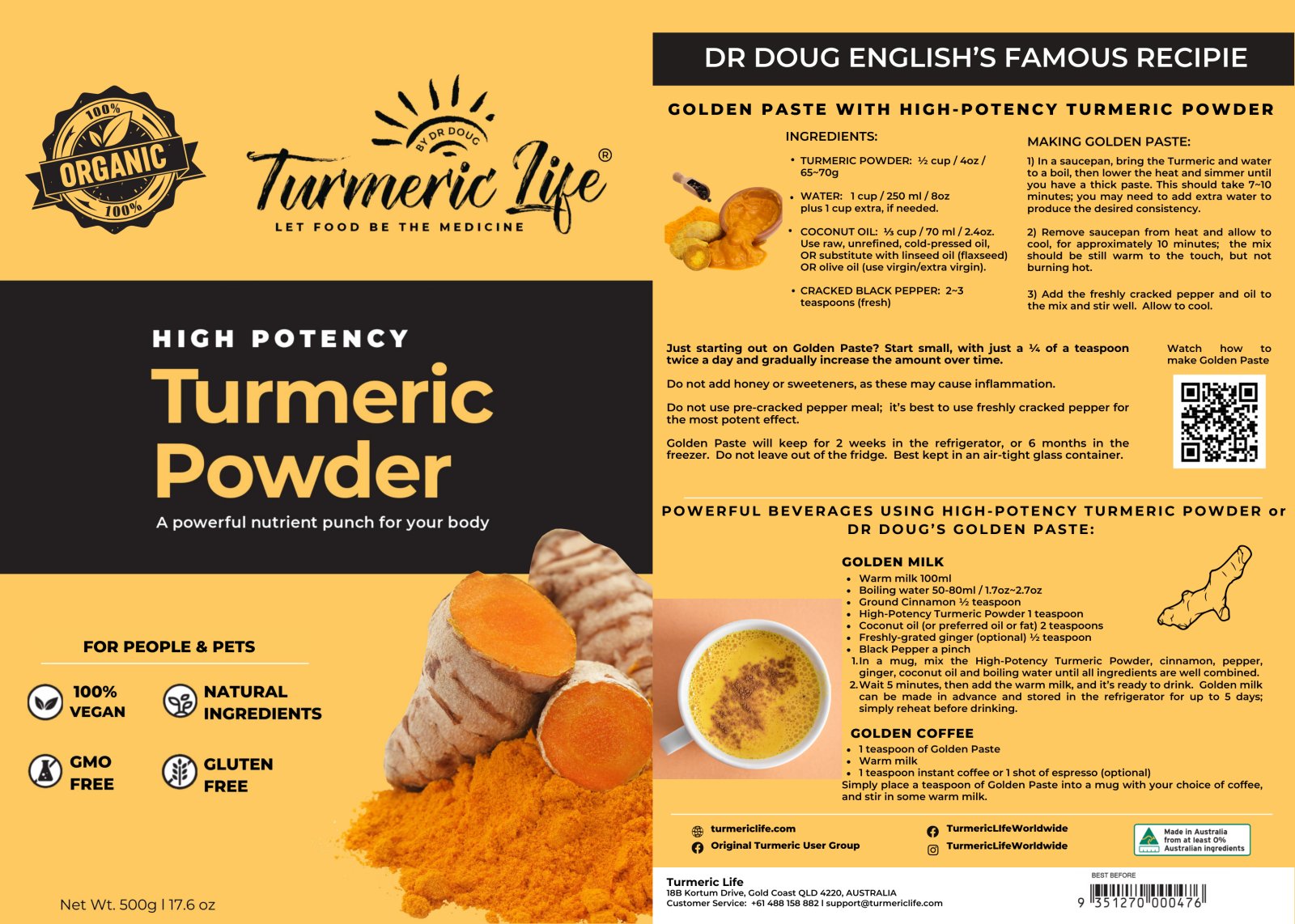
Copy Of 2023 May Turmeric Powder Label.pdf
Start at the lowest suggested amount and increase slowly only if your vet agrees. Keep a note of your dog's weight and the amount given so you can review it at your next appointment.
How to Introduce Turmeric to Dogs Safely
Introduce turmeric gradually over about a week:
- Start with a quarter of the recommended dose with food.
- Watch for changes in appetite, stool or skin for two to three days.
- Increase slowly to the full dose only if your dog is well.
- Stop and speak to your vet if you see vomiting, diarrhoea or itching.
For dogs that refuse supplements, try mixing a small amount into a familiar meal. Turmeric Life's guide to feeding turmeric to dogs covers several low-stress methods.
Checking for Turmeric and Medication Interactions in Dogs
Turmeric can interact with some medicines. Always tell your vet about any supplements your dog takes, especially if your dog is on medication. You can read about possible turmeric and drug interactions before that conversation.
Do not stop or change prescribed medication without your vet's advice. Turmeric is not a reason to skip a prescribed treatment.
Choosing Your Dog's Turmeric Supplement and Speaking With Your Vet
Bring the product label to your next vet visit. Ask whether the ingredients, dose and form suit your dog's age, weight and health. Your vet can also tell you whether a symptom your dog has needs investigating rather than supplementing. If you are worried about your dog's energy or weight, our plain-English guide to thyroid problems in dogs explains the signs and testing before you visit.
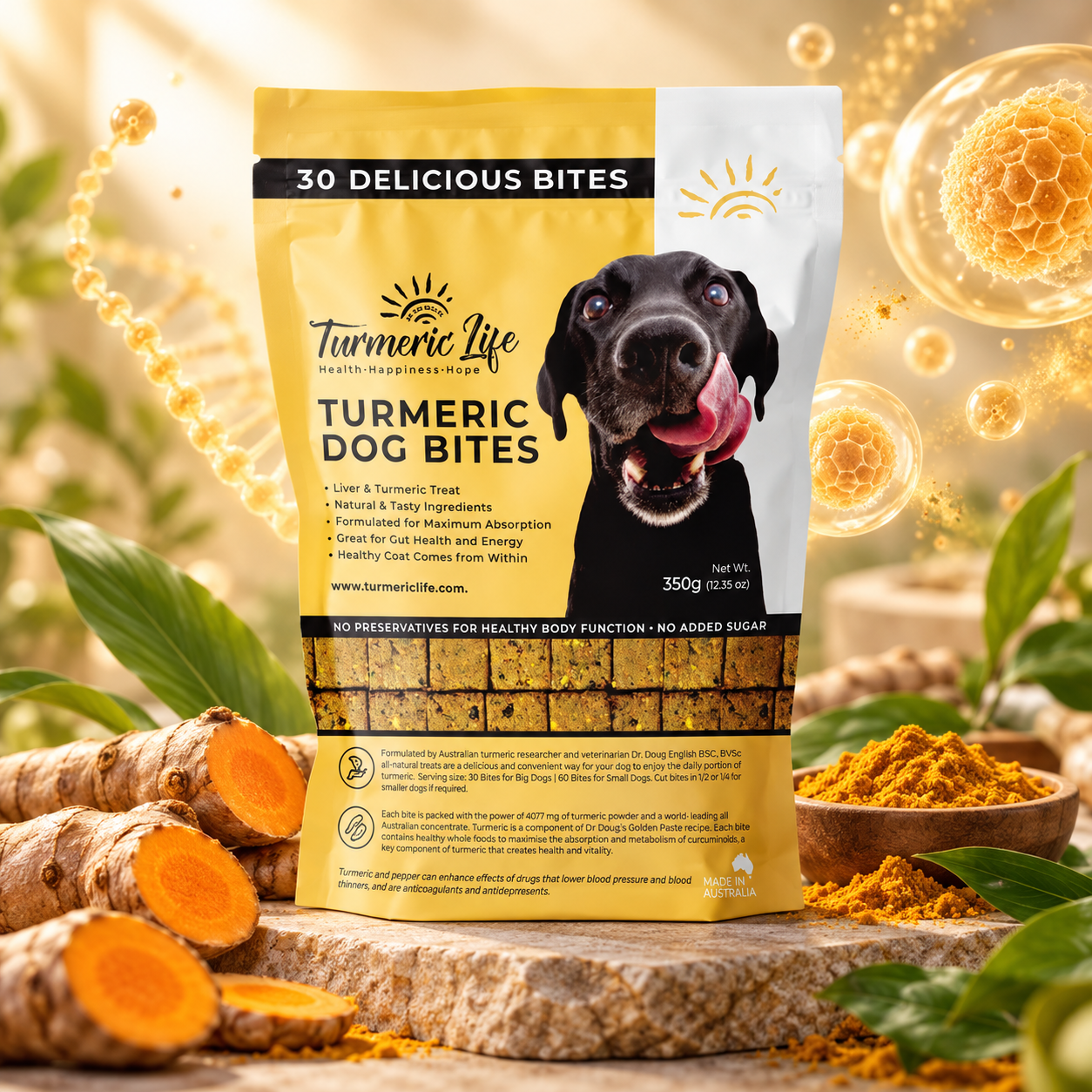
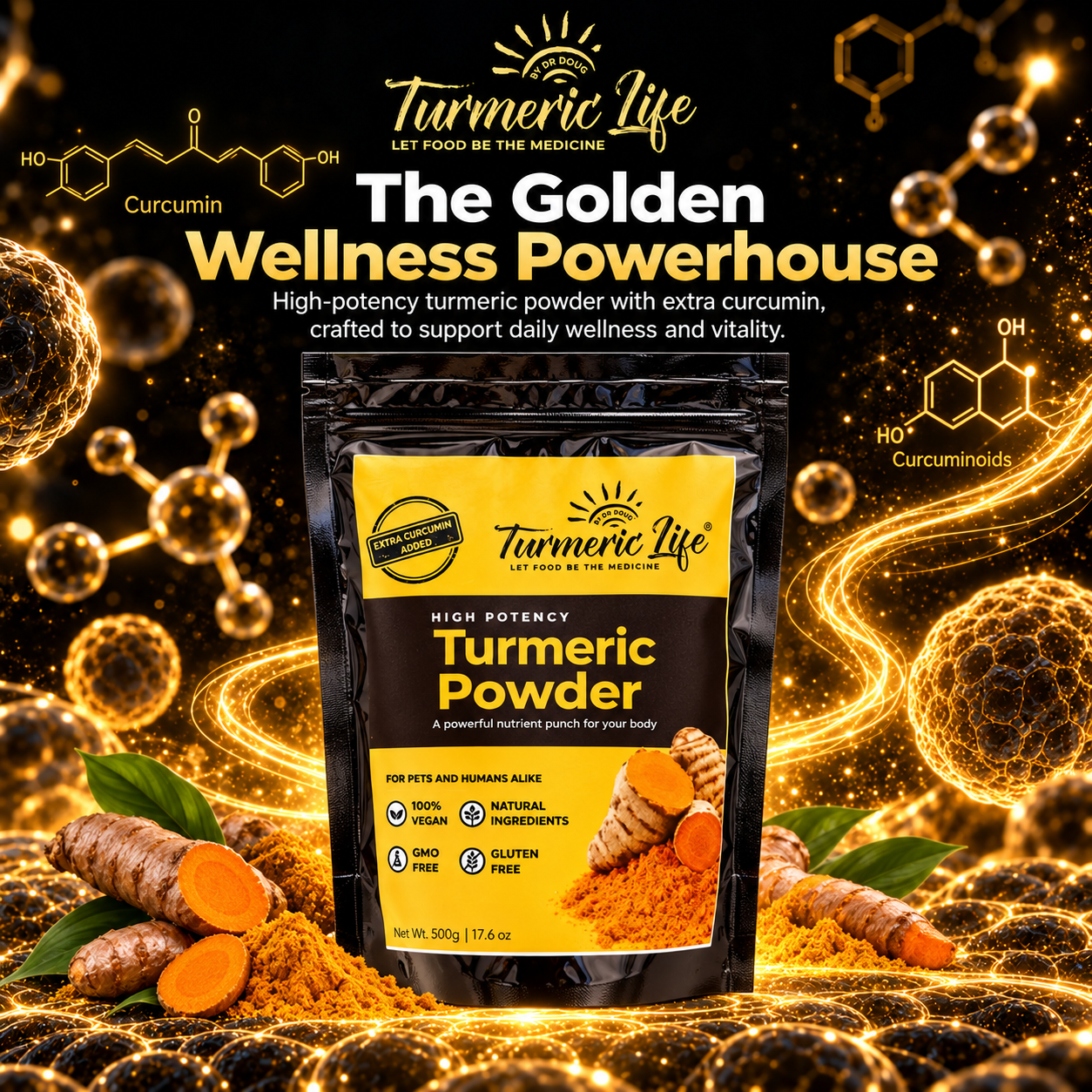
If you are looking at Turmeric Life's options, the TURMERIC DOG BITES by Dr Doug English are a daily wholefood supplement for dogs and list their full ingredients on the product page. For owners who prefer a simple root product, the Turmeric Powder 500g is an option to discuss with your vet. Read the full label, compare it against the checklist above, and confirm the choice with your vet before starting.
Frequently Asked Questions
What should I look for in a turmeric supplement for my dog?
Start with a short ingredient list that names turmeric or curcumin clearly, then check whether the curcumin content is declared. Look for a recognisable food-source base rather than a long list of fillers, preservatives, dyes or flavourings. Products that describe their formulation openly, including the source of the turmeric and any added carriers, are easier to assess. If the label is vague about what is inside, treat that as a reason to look elsewhere.
Do dogs need black pepper with turmeric?
Curcumin is poorly absorbed on its own, which is why many turmeric products pair it with black pepper and a healthy fat. Black pepper is a common carrier in dog supplements for this reason. Check whether the label lists it and whether that is a deliberate ingredient rather than an unexplained extra. If your dog has a sensitive stomach, introduce any combination gradually and watch for changes in appetite or stools.
Is turmeric powder or a supplement better for dogs?
Turmeric powder and a formulated supplement differ mainly in how much curcumin is delivered and how predictable the dose is. Powder varies in curcumin content from batch to batch, while a product with declared curcuminoid content lets you judge the dose more easily. Neither should be treated as a proven therapy. Discuss which form suits your dog with your vet, especially if your dog has existing health conditions.
Should I ask my vet before giving my dog turmeric?
Yes, particularly if your dog takes prescription medication, has a chronic condition, is pregnant or is about to undergo surgery. Turmeric may interact with some medicines, and a vet can check your dog's full medication list against the product label. Bring the packaging with you so the vet can see the exact ingredients and declared content.
